
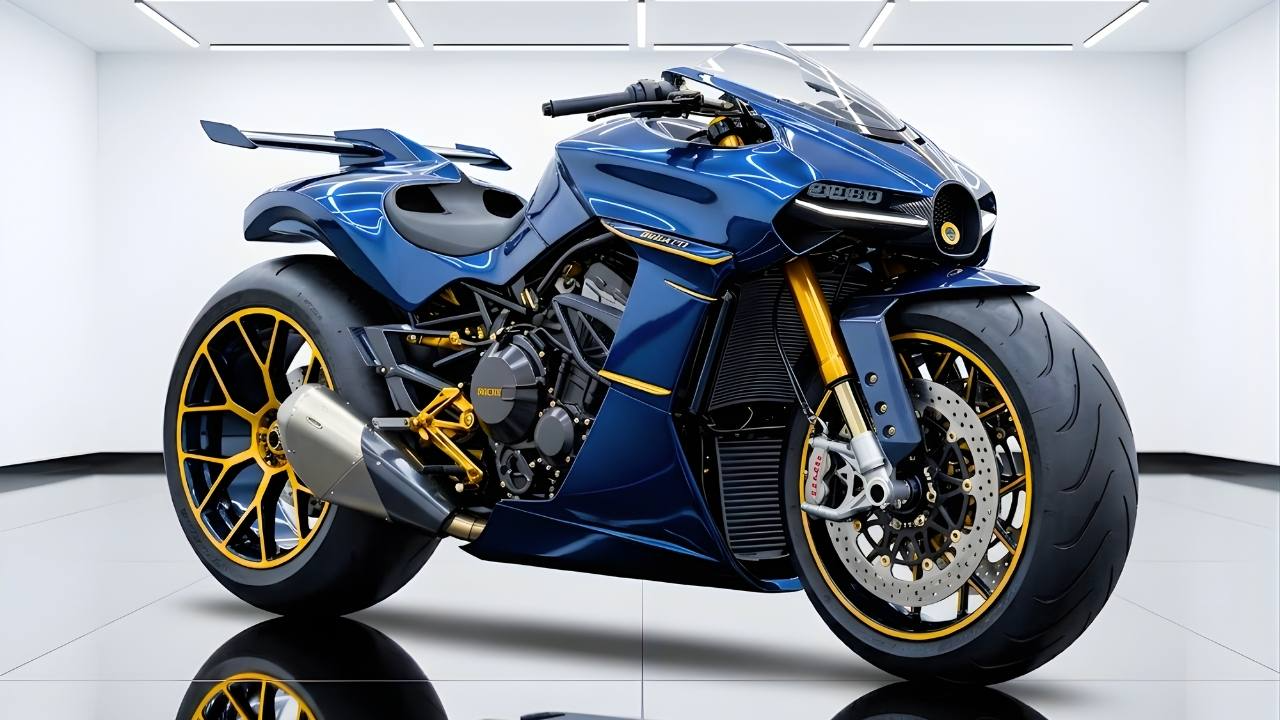
The idea of a Bugatti-branded superbike capable of 500 km/h has taken over social media feeds. Viral videos and slick concept renders suggest a futuristic machine that could redefine speed on two wheels.
But here’s the reality: there is no confirmed Bugatti superbike. The surge in attention highlights how quickly digital concepts can blur the line between engineering breakthroughs and online speculation—especially when a brand known for record-breaking performance is involved.
The Truth Behind the Bugatti Superbike Rumors
No Official Motorcycle Project
Despite widespread claims, Bugatti has not announced or launched any motorcycle. Most of the visuals circulating online are concept art, CGI creations, or AI-generated designs.
The brand’s engineering focus remains firmly on hypercars. While Bugatti is synonymous with quad-turbocharged powertrains, there has been no indication that such technology is being adapted into a two-wheeled platform.
Why the Internet Believed It
Bugatti’s reputation for pushing speed limits makes it an easy target for viral speculation. Combine that with dramatic headlines and futuristic visuals, and the result is a compelling—but misleading—narrative.
Claims vs Reality
| Feature | Viral Claims | Verified Reality |
|---|---|---|
| Engine | Quad-turbo W16 | Not confirmed |
| Top Speed | 500+ km/h | Unrealistic for motorcycles |
| Launch Status | Recently released | No official announcement |
| Manufacturer | Bugatti | No motorcycle division |
| Source | Social media, concept videos | Non-production designs |
Real High-Speed Motorcycles That Set Benchmarks
Track Machines and Experimental Concepts
While a 500 km/h production motorcycle remains unrealistic, several machines have pushed the boundaries of speed through real-world testing.
The Dodge Tomahawk, for example, is one of the most extreme concepts ever created. Powered by a V10 engine, it has theoretical speed claims nearing 500 km/h—but it was never fully tested at those levels and is not road legal.
Production and Track Performance Leaders
The Kawasaki Ninja H2R is widely recognized as one of the fastest track-only motorcycles ever built. It has exceeded 400 km/h in controlled conditions, thanks to its supercharged engine and advanced aerodynamics.
On the street-legal side, the MTT Turbine Superbike Y2K stands out. Using a turbine engine, it delivers extreme performance while remaining one of the fastest road-approved bikes ever produced.
Why 500 km/h on a Motorcycle Is So Difficult
Engineering and Physics Challenges
Achieving extreme speeds on a motorcycle is far more complex than in a car. Stability becomes a major concern, especially as aerodynamic forces increase exponentially at higher speeds.
Heat management, tire limitations, and rider safety all create barriers that make 500 km/h impractical with current technology.
Rider Control and Safety
Unlike cars, motorcycles rely heavily on rider balance and input. At speeds beyond 400 km/h, even minor instability can become uncontrollable, making such performance dangerous outside of specialized testing environments.
Bugatti’s Real Innovation Focus
Bugatti continues to lead in the hypercar space, where its engineering expertise delivers unmatched performance and luxury. The brand has also explored high-end collaborations, including limited-edition bicycles built with advanced materials.
These projects reflect Bugatti’s commitment to precision and exclusivity—without stepping into the motorcycle segment, at least for now.
Future of High-Performance Motorcycles
Speed Meets Efficiency
The next wave of motorcycles is expected to focus on smarter performance rather than just raw speed. Lightweight construction, improved aerodynamics, and hybrid or electric powertrains are shaping the future.
Technology and Practicality
Advanced rider aids, connected systems, and improved safety features are becoming just as important as top speed. For everyday riders, usability and efficiency matter more than extreme velocity figures.
Bugatti Superbike 500 km/h Myth Explained
The viral Bugatti quad-turbo superbike may look convincing, but it remains a digital fantasy rather than a real machine. While the dream of a 500 km/h motorcycle captures attention, current engineering realities keep such claims firmly in the realm of imagination.